
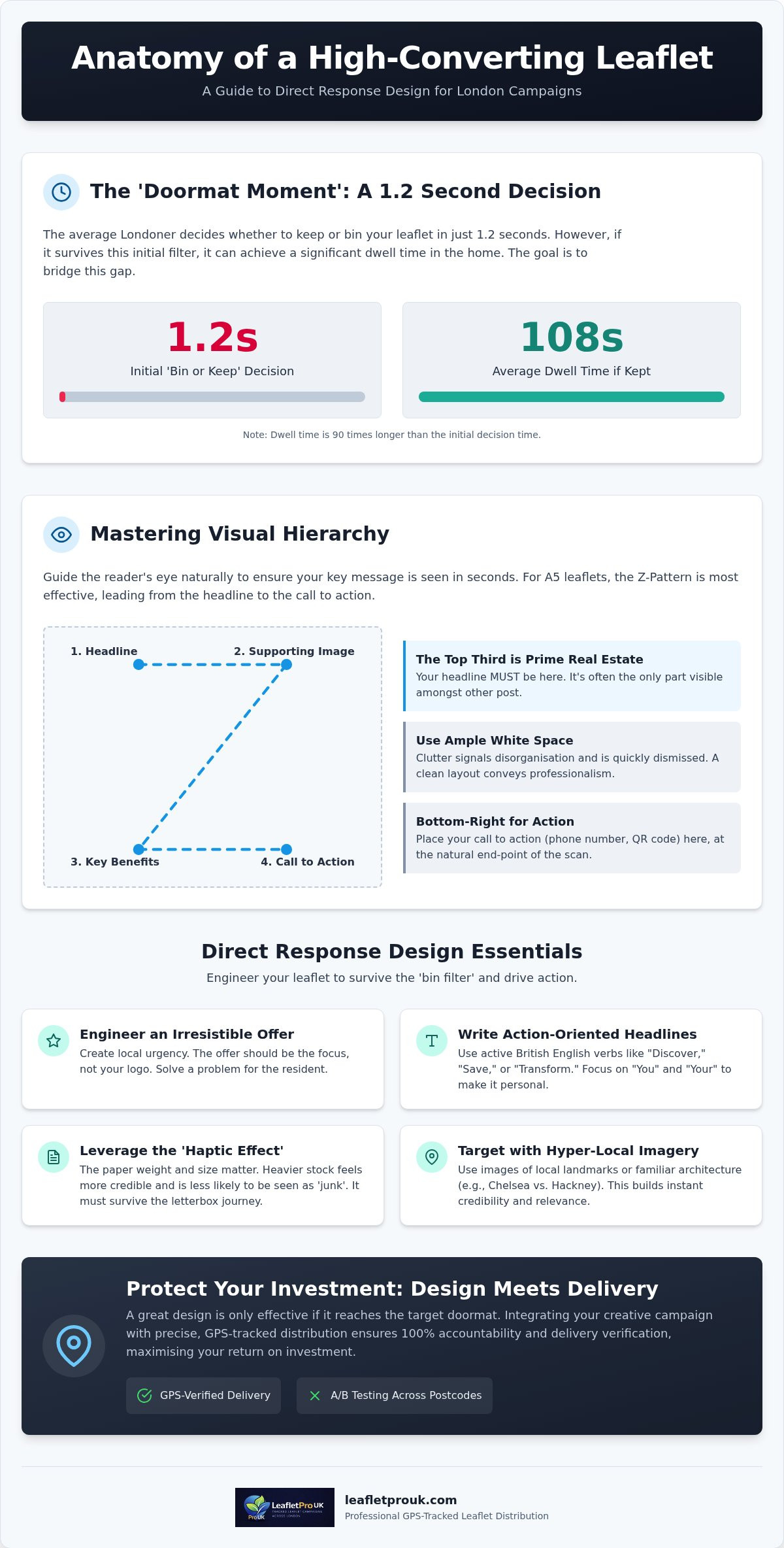
Did you know that 89% of people remember receiving a flyer, yet the average Londoner spends just 1.2 seconds deciding whether to keep it or bin it? Whilst the average marketing email is forgotten in seconds, a physical leaflet enjoys a dwell time of 108 seconds if it survives that initial "doormat moment." You've likely felt the frustration of seeing a significant investment in print yield unclear results, or perhaps you're worried about the high "bin rate" of previous campaigns. It's a common anxiety for businesses that value the tangibility of mail but require the accountability of modern logistics.
In this article, you'll discover essential direct response leaflet design tips to help you transform a simple flyer into a high-converting asset. We'll show you how to apply direct response psychology to capture attention and drive measurable action in the 2026 regulatory environment. We'll also preview how pairing professional design with GPS-verified distribution ensures your investment is handled with precision. By following this structured approach, you'll learn to engineer a London campaign that prioritises ROI and delivers a steady, reliable flow of new leads.
Key Takeaways
- Master the visual hierarchy of your flyer by using Z-pattern layouts that prioritise your headline in the most valuable real estate of the top third.
- Apply professional direct response leaflet design tips to engineer irresistible offers that utilise local urgency to drive immediate customer engagement.
- Leverage the "haptic effect" by selecting the correct paper weight and size to ensure your brand feels credible and survives the physical letterbox journey.
- Ensure your creative investment is protected by integrating design with GPS-tracked distribution for 100% accountability and delivery verification.
- Refine your campaign’s ROI by using A/B testing across neighbouring London postcodes to identify which messaging generates the highest response rates.
Understanding the 'Doormat Moment': The Psychology of Direct Response
The "doormat moment" is the precise second a resident picks up their post. In that fleeting window, your marketing asset is either categorised as a priority or dismissed as clutter. Direct response leaflet marketing differs from general brand awareness because it's engineered with a single, trackable goal in mind. Whether you want a QR code scan or a phone call, every element must drive that specific action. For a foundational perspective, you can read this overview of advertising mail to see how physical media remains a staple of direct marketing. This design-led approach only yields results if the physical delivery is as precise as the creative, which is why we prioritise GPS-verified distribution to ensure your assets actually reach the doormat.
Success depends on the 1.2-second rule. This is the time it takes for a recipient to subconsciously filter their mail. In London, this physical interaction varies by property type. A flyer pushed through a draught-excluded Victorian door in Dulwich might land face-down; one dropped into a communal mailroom in a Nine Elms high-rise might sit amongst dozens of others. You must design for these variables. Reducing cognitive load is essential. If a recipient has to work to understand your offer whilst sorting their bills, they'll simply bin it. Less is always more when you're competing with the daily post.
The 'Bin or Keep' Filter
To survive the initial sort, your design must avoid looking like "junk." This means moving away from cluttered, neon-soaked templates. Professional direct response leaflet design tips often suggest that your brand logo should never be the most prominent element. The recipient cares about their own problem, not your branding. Instead, use colour psychology to create contrast. Since many London hallways feature neutral tones, grey carpets, or wooden floors, using a bold, sophisticated palette helps your asset stand out from the floorboards without appearing garish or unprofessional.
Targeting Postcodes with Relevant Imagery
London is a patchwork of micro-markets. A design that resonates in the polished streets of Chelsea won't necessarily work in the vibrant, industrial-chic areas of Hackney. Effective direct response leaflet design tips include using imagery that reflects the local architecture or specific landmarks. Seeing a familiar park or a recognisable street scene builds instant credibility. It signals that you're a local expert rather than a distant national corporation. Tailoring your visuals to specific postcode demographics ensures your message feels personal and relevant. Using hyper-local imagery significantly reduces the "bin rate" by transforming a generic flyer into a community-focused message.
Mastering Visual Hierarchy: How to Guide a Londoner's Eye
Visual hierarchy acts as the strategic roadmap for your recipient's attention. Whilst many designers focus solely on aesthetics, effective direct response leaflet design tips prioritise the natural scanning habits of the human eye. For a standard A5 flyer, the Z-pattern is usually the most effective layout. It guides the reader from the top-left corner across to the right, then diagonally down to the bottom-left before finishing at your call to action in the bottom-right. This flow ensures no critical information is missed during the quick sort at the front door, whereas the F-pattern is often too restrictive for the limited space of a physical leaflet.
Your headline must occupy the top third of the page. This is the most valuable real estate because it's often the only part visible if the leaflet is partially covered by other post on the mat. To maintain professional credibility, ensure your claims align with truthful advertising standards; transparency is the foundation of local trust. Complement this with ample white space. Clutter creates visual claustrophobia, which signals a lack of organisation. A clean, spacious layout suggests a business that is methodical, reliable, and respectful of the reader's time.
Headline Secrets for Quick Action
Success starts with active verbs and British English power words that prompt immediate movement. Words like "Discover," "Save," or "Transform" create a sense of momentum. Shift the focus from your business to the resident by using "You" and "Your" throughout the copy. A Power Headline for a local London plumber might be: "Restore your home's heating today with our 60-minute emergency repair service in Islington." This headline identifies the problem, offers a specific solution, and establishes local relevance instantly.
Image and Graphic Placement
Hero images should anchor the reader's attention by visualising the outcome of your service. Place your primary image where it naturally intersects with the Z-pattern flow, usually in the centre or top-right. Use directional cues, such as the eyeline of a person in the photo or subtle arrows, to point directly toward your contact details. Icons are also highly effective for breaking up dense service descriptions into digestible points. If you're struggling to balance these layout principles, our experts offer leaflet design support that integrates these psychological triggers into every campaign.
The Anatomy of a High-Converting Offer and Call to Action
The offer serves as the engine of your marketing asset. Whilst many businesses assume a generic discount suffices, sophisticated direct response leaflet design tips focus on solving a specific resident problem. An "Irresistible Offer" might be a free structural survey for Victorian terrace owners in Fulham rather than a vague percentage off. This approach builds credibility and establishes you as a knowledgeable guide. To validate your strategy, you should be tracking leaflet distribution response rates London to see which hooks resonate most. Creating urgency through postcode-specific specials, such as "Exclusive to E1 Residents this Week," encourages immediate engagement before the leaflet is forgotten.
Trackable Response Mechanisms
Accountability relies on precise measurement. QR codes have become a standard in 2026, but they must be large enough to scan in low-light hallways. Aim for a minimum size of 20mm by 20mm. Don't simply direct people to your homepage; use dedicated landing pages that continue the conversation started on the doormat. Unique offer codes are another reliable method for tying a sale back to a specific London distribution zone. This level of visibility ensures you aren't guessing which areas of the city are driving your growth.
The 'Golden Rule' of Single-Action Design
Asking for multiple actions kills your conversion rate. If you request a phone call, a website visit, and a social media follow, the recipient often chooses none. Focus on one frictionless path. Even on physical paper, you can use a "Big Button" design by placing your CTA in a high-contrast, rounded box that mimics a digital interface. This makes the next step obvious. Always include a "What Happens Next" promise to manage expectations. Stating that a customer will receive a "Fixed-price quote within 4 hours" removes the friction of uncertainty and reinforces your brand's reputation for reliability.
Physical Specifications: Why Paper Weight and Size Impact Response
The physical sensation of your marketing asset is often the first tangible interaction a Londoner has with your brand. This is known as the "haptic effect." Research into consumer behaviour suggests that the weight and texture of a piece of mail directly influence the perceived value of the service offered. If your leaflet feels substantial, your business is perceived as established and reliable. Conversely, a flimsy sheet suggests a lack of permanence. Integrating these physical considerations into your direct response leaflet design tips ensures that your creative work isn't undermined by poor production choices.
Choosing between A5 and DL sizes depends on your specific campaign goals. A5 is the industry standard for London residential drops because it provides enough surface area for high-impact "hero" images whilst remaining easy to handle. DL (tri-fold) leaflets are better suited for service-heavy businesses, such as estate agents or renovation firms, who need to present detailed information without cluttering the layout. Regardless of size, your leaflet must be durable enough to survive the mechanical brushes of a letterbox and the occasional London rain. A silk finish is typically preferred for its professional, non-reflective surface that enhances readability under hallway lights.
Choosing the Right GSM (Grams per Square Metre)
Paper weight is measured in GSM, and finding the right balance is a logistical necessity. Whilst 150gsm is a cost-effective baseline that offers decent durability, moving to a 250gsm or 300gsm stock provides a premium, card-like feel that demands attention. Flimsy paper is the fastest route to the recycling bin. It lacks the structural integrity to stand out amongst other post. There is also a direct link between paper thickness and delivery accountability. Heavier stock is less likely to crumple or tear during the distribution process, ensuring that our GPS-tracked teams can deliver your message in pristine condition.
Folded vs. Single Sheet
A single-sheet A5 flyer is ideal for bold, time-sensitive offers where the goal is a quick QR code scan. However, if your business requires a more methodical explanation of complex services, a folded DL leaflet provides a structured journey for the reader. This format allows you to categorise information across six distinct panels, guiding the resident through your value proposition with logical transitions. By applying these direct response leaflet design tips to your physical specifications, you create a more professional and persuasive asset. If you're unsure which format best suits your postcode-targeted campaign, our team provides expert Professional Leaflet Design London to align your specifications with your ROI goals.
Integrating Design with GPS-Tracked Distribution for Maximum Accountability
Even the most scientifically engineered creative fails if it never reaches the intended letterbox. To avoid common leaflet marketing mistakes in London, you must view design and distribution as two halves of a single system. GPS-tracked delivery provides the empirical evidence required to trust that your investment is actually performing. Without this verification, you can't distinguish between a design that didn't resonate and a distribution that didn't happen. Professional direct response leaflet design tips only provide value when the physical asset is delivered with systematic precision.
Using GPS data allows for sophisticated A/B testing across neighbouring London postcodes. You can distribute one design variation in SW6 and a second in SW10, then monitor which call to action generates more traffic. This systematic approach identifies "Goldmine Areas," which are specific clusters of streets where your messaging resonates most strongly. By cross-referencing GPS reports with your response data, you gain a high level of visibility into the habits of your target audience. It allows you to move away from guesswork and towards a model based on tangible results and verified coverage.
The Power of GPS Proof
Transparent reporting transforms vague promises into tangible proof. When you review a GPS distribution map, you're looking at a granular record of every street traversed by the delivery team. This level of scrutiny ensures 100% accountability for your campaign. Matching response spikes to specific delivery times allows you to understand the lag between the "doormat moment" and the customer's action. This process builds long-term trust, as you can see precisely how your budget is being utilised across the city's complex logistics network. It's about ensuring your direct response leaflet design tips are backed by a reliable delivery mechanism.
Refining Your Strategy for the Next Drop
Data-driven refinement is the key to sustained ROI. The "Iterative Loop" involves four distinct stages: design, deliver, track, and improve. After your first drop, use the response data to tweak your next design iteration. Perhaps a specific headline worked better in Hackney than in Islington, or a certain paper weight saw higher engagement in residential areas. By constantly analysing these variables, you turn every campaign into a learning opportunity that sharpens your competitive edge. When you're ready to scale your results, book your GPS-tracked London campaign today to ensure your next distribution is handled with professional precision.
Transforming Your London Marketing into a High-Converting Asset
Mastering the "doormat moment" requires a methodical blend of psychological triggers and physical quality. By applying these direct response leaflet design tips, you ensure your message survives the initial sort and prompts immediate engagement through a frictionless call to action. Success isn't just about aesthetics; it's about the connection between a well-engineered offer and the integrity of the delivery process. We provide a complete design, print, and distribution solution that simplifies complex local logistics for your business.
Our expert London postcode targeting ensures your message reaches the right households, whilst our GPS-verified delivery for every household provides the transparency you need to measure ROI accurately. This systematic approach allows you to iterate and improve your results with every drop. You can now move forward with the confidence that your marketing investment is being managed with professional precision and care.
We look forward to helping you build a reliable and scalable lead generation engine in the heart of the capital.
Frequently Asked Questions
What is the best size for a direct response leaflet in London?
A5 is the most effective size for standard London residential drops because it provides the ideal surface area for bold visual hierarchy without being cumbersome. It fits easily through the diverse range of letterbox types found in Victorian houses and modern apartments. Whilst DL is useful for service-heavy businesses needing six panels of information, A5 remains the standard for high-impact offers that require immediate attention during the initial sort.
How many words should be on a high-converting flyer?
Aim for 50 to 100 words to ensure your message is digestible within the 1.2-second decision window. High-converting flyers prioritise clarity over volume. You should focus on a "Power Headline," three key bulleted benefits, and a single, clear call to action. Overloading the page with text increases cognitive load, which often leads to the recipient discarding the asset before they have even understood your core value proposition.
Do QR codes actually work on physical leaflets?
QR codes are highly effective in 2026 for bridging the gap between physical media and digital analytics. To ensure they work, place them in a high-contrast area and maintain a minimum size of 20mm by 20mm. Using a QR code allows you to direct residents to a dedicated landing page, making it much easier to track the specific ROI of your postcode-targeted campaign compared to general website traffic.
What paper weight (GSM) should I use for a professional look?
Use 250gsm to 300gsm paper stock if you want to project a premium and established brand image. This weight provides a card-like feel that survives the letterbox journey in pristine condition. Whilst 150gsm is a functional baseline for mass distribution, heavier stock leverages the "haptic effect," where the physical weight of the paper increases the recipient's perceived value of your service and builds instant credibility during the first interaction.
How do I track the ROI of my leaflet distribution campaign?
Tracking ROI requires the integration of specific response mechanisms into your design. You can use unique offer codes, dedicated landing page URLs, or tracked phone numbers to tie every lead back to a specific distribution zone. By following professional direct response leaflet design tips, you ensure that these tracking elements are prominent. Cross-referencing this data with our GPS distribution reports allows you to calculate the exact cost per lead for each London postcode.
Should I use a professional designer or a template?
Professional designers are recommended for campaigns where ROI is the primary objective. Whilst templates are cost-effective, they often lack the psychological engineering required to overcome the "bin or keep" filter. A designer who understands direct response principles can customise your visual hierarchy and imagery to suit specific London demographics. This bespoke approach ensures your asset looks like valuable information rather than generic junk mail, which significantly reduces your campaign's bin rate.
How does GPS tracking prove my leaflets were delivered?
GPS tracking provides a digital footprint of the distribution team's exact route through your target London postcodes. Every household reached is logged, creating a transparent map that verifies 100% coverage. This system eliminates the industry anxiety regarding "dumping" and provides empirical proof that your investment reached the doormat. It allows you to match response spikes to specific delivery times, ensuring complete accountability for your marketing spend across the city.
What is the average response rate for a London leaflet drop?
Typical response rates for a cold acquisition door drop in the UK range from 0.5% to 2% according to 2026 industry benchmarks. However, these figures vary based on the relevance of your offer and the precision of your targeting. Campaigns sent to a "warm" house file of existing customers often see much higher rates. Using direct response leaflet design tips to refine your messaging helps you stay at the higher end of these averages.


