

A marketing campaign is only as effective as its weakest link; in physical advertising, that link is too often a recycling bin at the end of a quiet London street. It's a common anxiety for business owners who invest heavily in high-quality print only to wonder if their message ever reaches its destination. You deserve to know exactly where your investment goes. You can replace guesswork with granular data by using GPS tracked leaflet distribution, ensuring that every flyer is delivered to a verified letterbox across your targeted postcodes.
We understand the frustration of traditional marketing methods that lack transparency and make it difficult to measure ROI. It's a challenge to feel confident in a campaign when you can't see the work being done with precision. This guide will show you how to secure total peace of mind by using verifiable delivery reports and professional oversight. We will explore the mechanics of GPS verification, the benefits of London-focused targeting, and how an end-to-end partner can streamline your design, print, and distribution into one reliable, professional workflow.
Key Takeaways
- Understand the history of the "trust gap" in London and why modern accountability is essential to prevent your marketing materials from being wasted.
- Learn how GPS tracked leaflet distribution works as a real-time monitoring tool to provide absolute certainty that your message is delivered.
- Compare the long-term costs of "cheap" unverified drops against the security of verified delivery to protect your business budget.
- Discover how to read professional heat maps and delivery reports to verify that every house in your chosen postcode has been reached.
- See how combining professional design and print with tracked distribution creates a seamless, end-to-end campaign focused on tangible results.
The Evolution of Leaflet Distribution: Why GPS Tracking is Essential in London
For decades, the London distribution industry suffered from a significant "trust gap." Business owners spent substantial budgets on design and print, only to hand their assets to distributors with no way of knowing if those flyers actually reached a letterbox. This lack of oversight led to the notorious problem of "fly-tipping," where bundles of marketing material were dumped in bins or hidden in bushes to save time. For a long time, traditional leaflet distribution relied on blind faith, which often resulted in wasted capital and missed opportunities.
The Risks of Unverified Distribution
Choosing unverified delivery means gambling with your marketing budget. Common pitfalls like "skimming," where a distributor delivers only to every third house, or complete dumping can decimate your response rates. Without data, it's impossible to calculate a true ROI. If you can't verify which streets were covered, you can't correlate a spike in enquiries with a specific postcode. This financial leak makes physical campaigns feel like an expensive risk rather than a strategic investment. It's a problem that has plagued the industry for years, leaving businesses hesitant to commit to large-scale drops.
Restoring Business Confidence Through Transparency
Modern London brands are moving away from blind faith and toward data-driven accountability. The shift to GPS tracked leaflet distribution has transformed physical marketing from a speculative tactic into a precision tool. By providing verifiable delivery evidence, we eliminate the anxiety of the "unknown." There's a profound psychological benefit to seeing a digital trail of your campaign's progress. You can see exactly where your distributors have walked, ensuring total coverage of your target area and protecting your marketing spend from unreliable practices.
Maintaining professional standards protects your reputation amongst London residents. A well-executed, respectful delivery reflects the quality of your brand. When residents see that your materials are handled with care rather than scattered carelessly, it builds immediate credibility. Using GPS tracked leaflet distribution ensures your investment is protected and your brand's integrity remains intact throughout the capital. This level of scrutiny is no longer a luxury; it's the gold standard for any business serious about local engagement.
How GPS Tracked Leaflet Distribution Works: A Technical Overview
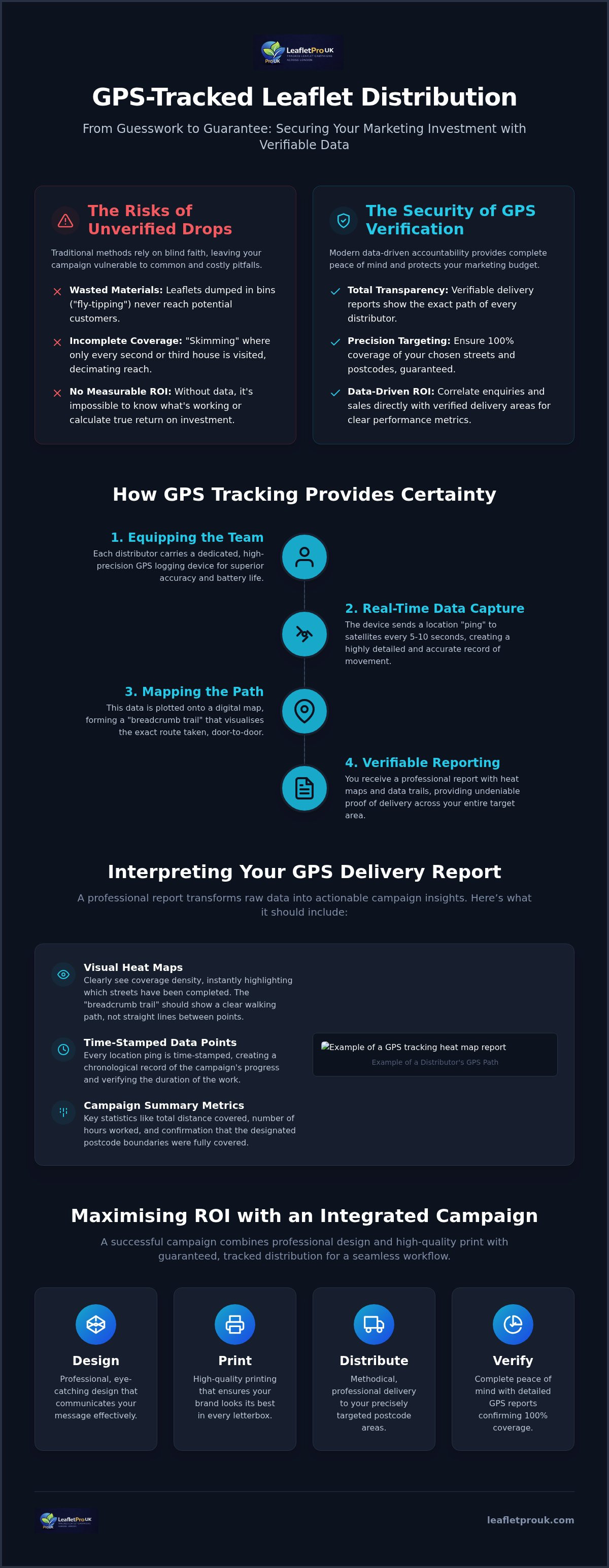
GPS tracked leaflet distribution is a sophisticated logistical process designed to provide absolute visibility over your marketing campaign. At its core, it is a real-time monitoring system that records every step a distributor takes. The journey begins with a signal transmitted from a GPS device carried by the delivery team. This signal is processed by satellites and recorded as a precise data point. For high-precision mapping, these pings must occur at high frequencies, typically every five to ten seconds, to ensure that the digital path reflects a genuine door-to-door walk rather than a vague street-level summary.
This technical precision is particularly important for London-wide campaigns. The city's complex layout requires a methodical approach to ensure every letterbox is reached. By integrating GPS data with postcode targeting, we can ensure that your flyers are delivered exactly where they are intended to go, whether that is a specific street in Chelsea or a wider residential area in Greenwich.
The Hardware and Software Behind the Track
Professional campaigns often rely on dedicated GPS loggers rather than simple mobile apps. Whilst mobile phones are convenient, dedicated loggers offer superior battery life and more robust signal retention amongst London's tall buildings and narrow mews. These "urban canyons" can sometimes interfere with satellite signals, but high-quality hardware is designed to maintain accuracy in dense environments. Every delivery point is time-stamped, creating a chronological record of the campaign's progress. This level of detail is vital for postcode-targeted flyer distribution where accuracy is the primary measure of success.
Mapping the Distributor’s Path
The resulting data is visualised as a "breadcrumb trail" on a digital map. This allows us to synchronise the distributor’s actual path with specific London postcode boundaries. By overlaying this data, our software can instantly identify any gaps in coverage or streets that were inadvertently missed. This systematic approach ensures that every household in your target area receives your message. It turns a complex city-wide drop into an organised and verifiable operation, providing the transparency that modern businesses require. This mapping process creates an undeniable link between the logistical effort and the final delivery outcome.
Comparing Distribution Methods: GPS-Verified vs. Traditional Drops
Choosing between unverified delivery and GPS tracked leaflet distribution is the difference between hoping for a result and planning for one. Traditional methods often leave businesses in a state of uncertainty. You might receive a brief email stating an area is "complete," yet you have no way to verify the claim. This lack of evidence is where marketing budgets often disappear. In contrast, a verified service provides a digital footprint that establishes a clear standard of accountability for every member of the delivery team.
Whilst "cheap" unverified services might look appealing on a quote, they frequently prove to be the most expensive option in the long run. If a significant portion of your flyers never reaches a letterbox, your cost per lead increases dramatically. You've already paid for the design, the paper, and the ink; failing to ensure delivery at the final stage is a costly oversight. Professional, tracked teams are managed with a focus on diligence, knowing that their performance is recorded and reviewed against specific postcode targets.
Accountability and Reporting Standards
Traditional reporting is often anecdotal and vague. You're left to trust the word of a distributor you've never met. A professional GPS report, however, is a comprehensive PDF document that provides empirical evidence of coverage. These reports include detailed maps showing the exact route taken by the distributor. This level of scrutiny directly influences distributor behaviour. When staff are aware that their progress is being monitored, they are far more likely to be thorough, ensuring that even the most tucked-away London mews or high-density flat blocks receive your message.
Precision Targeting in the London Market
London's residential landscape is diverse and complex. Using GPS history allows you to refine your future campaigns based on actual coverage data from previous drops. This prevents the issue of "over-saturation," where the same households are targeted too frequently, which can damage brand reputation. Bespoke London knowledge is vital here. Unlike national services that might treat every city the same, a London-specialist partner understands the nuances of specific boroughs. By combining this local expertise with precise tracking data, you can make informed decisions about where to focus your next campaign for the best possible ROI.
Interpreting Your Campaign Data: What a Professional GPS Report Should Show
Receiving a report is the final step in the GPS tracked leaflet distribution process, providing the tangible proof needed to validate your marketing spend. A professional report shouldn't be a simple list of streets. Instead, it should present a comprehensive visual and data-driven summary of the distributor's activity. At the centre of this document is the heat map, a colour-coded overlay of your targeted London postcode. This map allows you to see the density of coverage at a glance, with the distributor's path clearly marked as a continuous line through every residential road.
A legitimate report must include specific chronological data. You should be able to identify the exact start and end times for each day of the delivery. If a report lacks these timestamps, or if the route appears as a series of disconnected dots rather than a fluid path, it may indicate low-quality tracking or manual data entry. Transparency is the priority here; a credible partner will provide the raw data that proves their team was physically present at every letterbox.
Key Metrics for Marketing Managers
To evaluate the success of your drop, focus on three primary metrics:
- Percentage of Postcode Coverage: This confirms how much of your intended area was actually reached.
- Total Households Reached: This figure should align with your initial print run and target demographic data.
- Average Distribution Speed: A distributor walking at a steady pace usually covers a predictable number of houses per hour. If the speed appears excessively high, it's a significant red flag that suggests the distributor may have skipped houses or "skimmed" the street.
Auditing Your Distributor’s Performance
While the data provides security, you can further protect your brand by cross-referencing GPS tracks with your own spot checks. If you notice a specific street has been missed on the map, a professional provider will address the discrepancy immediately and rectify the coverage. A high-quality report is one that provides 100% verification through a continuous, time-stamped digital trail that matches the physical boundaries of your targeted London postcode. By insisting on this level of detail, you ensure that your flyer distribution London campaign is handled with the integrity your business requires.
Maximising ROI: Integrating Design, Print, and Tracked Distribution
Whilst GPS tracked leaflet distribution provides the necessary evidence that your flyers have reached their destination, the quality of the physical material determines the final response rate. A verified delivery is a significant milestone, but the campaign's ultimate success depends on what happens once the leaflet is picked up from the doormat. Integrating professional design and high-quality printing with a tracked delivery strategy ensures that your message doesn't just arrive; it resonates with the recipient.
Even the most precise tracking data cannot compensate for a leaflet that fails to engage. The "letterbox experience" is a brief but critical window of opportunity. If a flyer feels flimsy or looks cluttered, it's likely to be discarded regardless of how accurately it was delivered. By coordinating the entire lifecycle of your campaign through a single London partner, you ensure a consistent level of quality from the initial concept to the final delivery report.
The Power of Professional Leaflet Design
A clear, compelling call-to-action is the foundation of a successful campaign. In a busy city like London, your design must compete with a high volume of daily post. Professional design support helps you create a layout that guides the reader's eye toward your most important information. This includes choosing the right paper weight and finish to convey a premium feel. A 170gsm or 250gsm silk finish provides a tactile sense of authority that cheaper, thinner papers lack. It is also essential to align your design with the specific demographics of your target postcode, ensuring the tone and imagery reflect the local community's expectations.
Streamlining the Campaign Process
The "Design-Print-Distribute" model is the most efficient way to manage a London campaign. This integrated approach reduces logistical headaches by removing the need to coordinate between multiple third-party vendors. When one team handles the entire process, there is less risk of delays or miscommunications regarding print specifications and delivery deadlines. It allows for a seamless transition from production to the street, ensuring your GPS tracked leaflet distribution begins exactly when planned.
Managing your campaign through a unified workflow provides a level of oversight that fragmented services cannot match. You receive the peace of mind that every stage is being handled with professional scrutiny and a focus on your specific ROI goals. Ready to organise a verified London campaign? Contact LeafletPro UK today.
Secure Your London Campaign with Data-Driven Precision
Transitioning from traditional, unmonitored drops to a verified model is the most effective way to protect your marketing budget. Technical transparency eliminates the historical "trust gap" that has long affected the London market. By prioritising GPS tracked leaflet distribution, you replace uncertainty with empirical evidence, ensuring every flyer reaches a verified letterbox across your target postcodes. This level of scrutiny turns a speculative tactic into a precision marketing tool.
Success in the capital requires more than just delivery; it demands a synergy of specialist London postcode knowledge and high-quality production. We provide a comprehensive, integrated service that combines professional design support and print with 100% GPS-tracked routes. This end-to-end approach ensures your brand message is delivered with the precision and care it deserves. By choosing a partner who values accountability over vague promises, you secure the peace of mind that every penny of your budget is working to reach your audience.
Request a quote for GPS-tracked distribution in London today to start planning a campaign built on transparency and professional integrity. We look forward to helping you achieve a reliable and measurable return on your marketing investment.
Frequently Asked Questions
What is GPS tracked leaflet distribution?
GPS tracked leaflet distribution is a professional delivery method where distributors carry digital loggers to record their precise movements. This process creates a verifiable digital record of every street and letterbox visited during a campaign. It provides businesses with the transparency needed to confirm that their marketing materials have reached their intended destinations across London, effectively replacing the traditional reliance on blind faith.
How accurate is the GPS tracking for door-to-door delivery?
Modern GPS loggers are highly precise, typically recording a data point every five to ten seconds. This frequency allows for street-level mapping that shows the distributor's path right up to individual letterboxes. Whilst environmental factors can occasionally influence signal strength, these systems are designed to maintain a reliable breadcrumb trail through even the most densely populated London residential areas.
Can I see the GPS reports whilst the campaign is still in progress?
Reports are finalised and provided once a specific postcode or campaign phase is complete to ensure total data integrity. This allows our team to verify the logs and create a comprehensive PDF summary for your review. Waiting for the completed data ensures you receive a clean, accurate heat map that reflects the total coverage of your targeted London postcodes without the confusion of incomplete logs.
Does GPS tracking guarantee that my leaflets won’t be dumped?
Tracking acts as a powerful deterrent against dumping because distributors are aware that their every movement is being recorded and reviewed. Whilst no technology can physically stop a person's actions, the presence of a GPS logger ensures that any significant gaps or suspicious activity are immediately visible. We use this data to maintain a high standard of integrity across our entire delivery team.
Is GPS tracked distribution more expensive than standard delivery?
GPS tracked leaflet distribution is a security measure that protects your marketing investment. Whilst traditional unmonitored drops might appear cheaper on a quote, the risk of wasted materials often leads to a much higher cost per lead. Tracking ensures your entire budget is used effectively by providing empirical proof that your message reached your target audience in the most efficient way possible.
What happens if the GPS signal is lost in a high-rise London building?
London's architecture can occasionally cause brief signal interruptions, often referred to as urban canyons. Professional loggers are equipped to handle these temporary drops by reconnecting as soon as a line of sight to satellites is restored. Our team cross-references these brief gaps with the distributor's overall route and time-stamps to ensure the delivery process remained consistent and thorough throughout the block.
How do I know the GPS report hasn’t been faked by the distributor?
Faking a professional GPS report is extremely difficult because the data includes specific chronological time-stamps and continuous path logs. Sophisticated software identifies disconnected paths or impossible walking speeds that would suggest manual tampering. We review all route data against expected delivery timeframes to ensure the reports represent genuine, physical walks through your target streets rather than fabricated data.
Do you provide GPS tracking for hand-to-hand distribution in London?
We focus exclusively on door-to-door delivery to residential letterboxes to maintain a high standard of quality and precision. We don't offer hand-to-hand distribution in public areas or transport hubs as part of our service. This specialisation allows us to provide more detailed postcode-targeted reports and ensure that your marketing materials reach the homes of your potential customers with absolute reliability.


