

What if the greatest threat to your marketing budget isn't a poor design or a weak offer, but the simple uncertainty of whether your leaflets ever reached their destination? For many London business owners, the "trust gap" in physical marketing is a significant hurdle, often fuelled by the fear that thousands of printed materials might be discarded before they ever see a letterbox. It's difficult to justify a marketing spend when the results feel untraceable and the process lacks visibility.
We believe that transparency is the foundation of a successful partnership, and you deserve to know exactly where every penny of your investment is going. Learning how to track flyer distribution effectively turns a leap of faith into a data-driven strategy. By utilising precise GPS verification and professional reporting, you can eliminate the anxiety of "binning" and ensure every postcode in your campaign is covered with absolute precision.
This guide provides a clear roadmap for interpreting tracking data and verifying doormat-level accountability. You'll learn how to read route density maps, understand the logistics of professional distribution teams, and gain the confidence to reinvest in leaflet marketing as a reliable, measurable pillar of your business growth.
Key Takeaways
- Understand why transparent verification is essential to protect your marketing budget and eliminate the uncertainty of unverified door-to-door campaigns.
- Discover the technical mechanics of how to track flyer distribution using satellite-linked devices that record the precise path of every distributor in real-time.
- Learn how to interpret professional distribution maps by identifying route density and recognising human-specific walking signatures that confirm genuine delivery.
- Explore the importance of a multi-layered verification approach that combines GPS data with independent supervisor spot-checks for maximum accountability.
- Gain the confidence to reinvest in London-wide marketing by receiving clear, postcode-specific reports that provide total visibility of your campaign's progress.
The Trust Gap: Why You Must Track Flyer Distribution
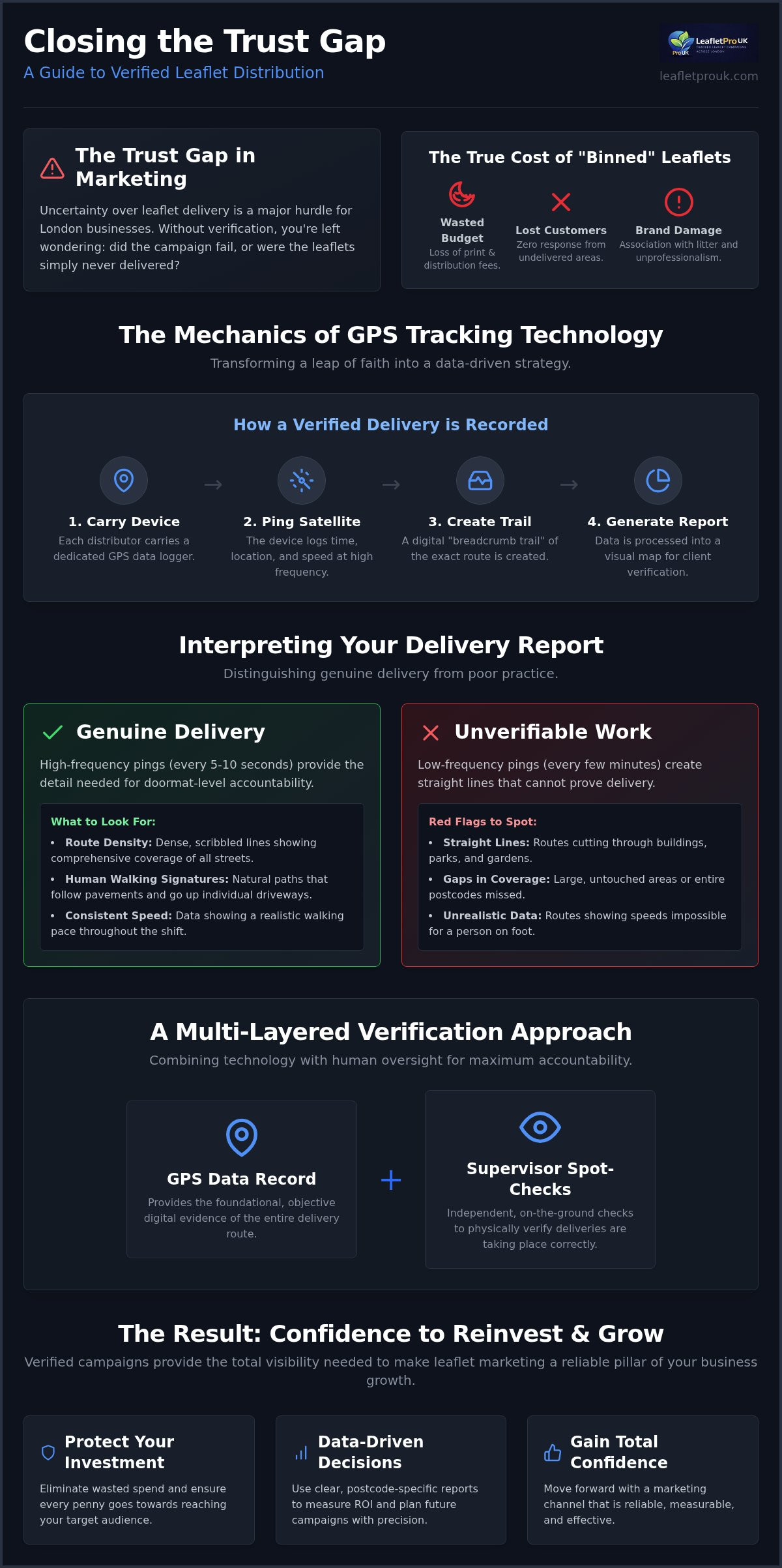
For years, door-to-door marketing felt like a "black box" for many London business owners. You'd invest in high-quality printing, hire a distribution team, and then simply wait for the phone to ring. If the enquiries didn't materialise, you were left with a frustrating dilemma. Did the creative fail to resonate, or did the leaflets never actually reach the intended doormats? This lack of transparency creates a significant trust gap, often leading businesses to abandon a highly effective marketing channel because they can't verify the work was completed.
Understanding how to track flyer distribution has moved from being a technical curiosity to an absolute business necessity. In a competitive urban landscape, unverified distribution leads to skewed ROI and wasted marketing spend that most SMEs cannot afford to ignore. GPS tracking has transitioned from a premium add-on to an industry security standard, providing the objective evidence needed to bridge the trust gap. It offers a level of visibility that turns a leap of faith into a professional, data-driven operation.
The Real Cost of "Binned" Leaflets
When a distributor discards materials instead of delivering them, the financial damage is multifaceted. You don't just lose the initial cost of the print and the distribution fee; you lose the potential lifetime value of every customer who never saw your message. If a Flyer (or flier) is never delivered, your response rate is guaranteed to be zero. Beyond the immediate loss of leads, there's a serious risk to your brand reputation. Residents who find bundles of your branded leaflets dumped in communal areas or local parks will associate your business with litter and unprofessionalism. Choosing "cheap," unverified distribution is frequently the most expensive mistake a business can make.
Establishing Accountability with Your Distribution Partner
Accountability begins long before the first leaflet is dropped. A professional partnership is built on clear expectations and a shared commitment to campaign integrity. By insisting on transparent reporting from the outset, you establish a framework where results are measured by data rather than vague promises. This transition from a "trust me" model to a "here is the evidence" approach fosters a much stronger long-term relationship. When you have access to precise route data, you gain the peace of mind required to scale your marketing efforts. Reliable verification ensures that your investment is handled with the same level of care and precision that you apply to every other area of your business.
The Mechanics of GPS Leaflet Tracking Technology
At its core, GPS tracking for physical marketing is the systematic use of satellite-linked devices to record the precise movements of a distributor. This technology removes the ambiguity of manual reporting by capturing coordinates at regular intervals whilst a team is on the ground. Understanding how to track flyer distribution requires a basic grasp of how these data points are transformed into a transparent record of work. The process begins with hardware that communicates with a network of satellites to log time, location, and speed, creating a digital breadcrumb trail of the entire delivery route.
The hardware used in the field generally falls into two categories: dedicated portable data loggers or mobile application tracking. Whilst smartphone apps are convenient, professional logistics firms often prefer dedicated GPS loggers. These devices are built for a single purpose, offering superior battery life and more robust signal reception in dense London urban environments where high-rise buildings can sometimes interfere with satellite links. Once a shift is completed, the raw data is uploaded to a central server and processed into a visual map that provides clear evidence of coverage.
Data Loggers vs. Live Tracking
There's a significant difference between receiving a post-campaign report and monitoring a live feed. Live tracking allows for immediate oversight, but the true value lies in the "ping interval" of the device. A high-frequency ping, occurring every five to ten seconds, is essential for doormat-level accuracy. If a device only pings every few minutes, the resulting map will show straight lines cutting through buildings and parks, failing to prove that the distributor actually walked up every driveway. By selecting a partner that utilises high-resolution GPS tracked leaflet distribution, you ensure the data is granular enough to verify every single letterbox visit.
Geo-fencing and Postcode Boundaries
Geo-fencing is a digital tool that creates virtual boundaries to ensure postcode-targeted precision during a campaign. This software is vital for maintaining the integrity of a London-specific drop, as it alerts supervisors if a distributor wanders outside the pre-authorised zone. It prevents "over-spill" into irrelevant areas, ensuring your marketing budget is concentrated exactly where your target demographic lives. This systematic approach is the most reliable way to learn how to track flyer distribution with absolute certainty, as it combines satellite data with strict geographical constraints to guarantee that no leaflets are wasted in non-targeted postcodes.
Interpreting Your Flyer Delivery Tracking Data
Receiving a GPS report is a significant milestone in any campaign, yet the real value lies in your ability to analyse the data provided. A series of lines on a digital map might look impressive at first glance, but you must look closer to verify that every household was reached. Learning how to track flyer distribution effectively means looking beyond the simple presence of a path and scrutinising the specific behaviours recorded by the hardware. A genuine, house-by-house delivery will produce a distinct pattern that reflects the physical reality of navigating London’s residential streets.
One of the most vital indicators is the "walking pace" signature. A distributor who is actually visiting doors will move at a steady pedestrian speed, usually between two and three miles per hour, with frequent pauses at every letterbox. If the report shows a speed that remains consistently high or a path that never deviates from the centre of the road, it is a clear sign that the delivery was not completed to a professional standard. Time-stamped data adds another layer of security; it allows you to cross-reference the duration of the drop with the expected time required to cover that specific number of households.
Spotting the Red Flags in a Report
When you review your tracking data, stay alert for "straight-line" pings. These occur when a device loses signal or is purposefully turned off and then back on, resulting in a straight line that cuts through buildings or parks. Whilst occasional signal loss is possible in dense urban areas, frequent straight lines suggest a lack of accountability. Similarly, "street-only" walking patterns are a major concern. If the GPS track follows the road perfectly without showing the zig-zag movement into driveways and up to porches, it is highly likely that the distributor simply walked the route without delivering your materials. Don't hesitate to question your provider if a certain street appears neglected or if the data doesn't align with the physical layout of the neighbourhood.
Verifying Route Density
Counterintuitively, a "messy" map is often the hallmark of a successful campaign. A map filled with dense, overlapping lines indicates that the distributor was thorough, crossing the street repeatedly to ensure no door was missed. You should compare these GPS tracks against your targeted postcode list and the known household counts for those areas. This level of scrutiny allows you to confirm 100% coverage of specific London residential blocks, especially in high-density areas where letterboxes are close together. Understanding how to track flyer distribution involves more than just seeing a line on a screen; it requires a critical eye for detail to ensure the density of the tracking dots matches the density of the housing.
Beyond GPS: Multi-Layered Verification Methods
Whilst GPS tracking provides an objective record of movement, it remains the foundation rather than the final word in campaign integrity. In the dense and often complex residential layouts of London, satellite data alone cannot always confirm the quality of a delivery. High-rise estates or Victorian conversions with communal entrances require a more nuanced approach to ensure every leaflet is placed correctly. Learning how to track flyer distribution effectively involves combining technical satellite data with human oversight and digital response metrics to create a fail-safe verification system.
Professional distribution models now incorporate multi-layered strategies to bridge any remaining gaps in visibility. This includes physical spot-checks and back-checking, where managers verify the presence of materials shortly after a drop. These methods provide a level of qualitative proof that a GPS map cannot offer on its own. By layering these techniques, you move from simply knowing where a distributor walked to knowing exactly how your brand is being presented to the local community.
The Importance of Physical Supervision
Random site visits by independent supervisors are a critical component of a secure distribution model. These managers conduct unannounced inspections whilst a team is on the route, ensuring that distributors are diligent and respectful of "no junk mail" signs. This "supervisor effect" significantly improves distributor behaviour and accuracy, as staff are aware that their work is subject to physical scrutiny at any moment. Combining human oversight with satellite precision creates a total security framework that protects your marketing investment. This approach is particularly effective in high-density London postcodes where letterbox access can be challenging and requires a professional touch.
Digital Response Tracking
Integrating digital response tools like QR codes or unique URLs allows you to validate physical distribution through real-world engagement. When a resident scans a code on your flyer, it creates a timestamped digital hit that can be cross-referenced with your GPS reports. If a specific street shows high GPS density and a corresponding spike in digital traffic, you have definitive proof of a successful drop. This data allows you to create a "heat map" of success, overlaying satellite routes with conversion statistics to identify your most profitable neighbourhoods. To ensure your next campaign meets these rigorous standards, consider a partner that provides postcode-targeted flyer distribution with full verification.
The 2026 trend in physical marketing is moving towards this total transparency model. Beyond satellite logs, some providers now conduct follow-up checks by knocking on a small percentage of doors to confirm receipt. This scientific framework replaces anecdotal evidence with hard data, giving you the confidence to scale your local London outreach with absolute certainty.
Organising a Verified Campaign with LeafletPro UK
At LeafletPro UK, we've built our reputation on the principle that transparency shouldn't be a luxury. Every London campaign we manage includes 100% GPS-tracked distribution as standard. This commitment ensures that the trust gap discussed earlier is completely bridged. By choosing a partner that understands the intricate layout of the capital, you gain access to a service that values evidence over promises. We provide clear, understandable reports that show exactly where your marketing materials have landed, giving you the business-like confidence to scale your outreach.
Our postcode-targeted approach is designed for local brand growth. We don't just walk the streets; we target the specific neighbourhoods that match your ideal customer profile. Understanding how to track flyer distribution becomes simple when you are presented with a clean, professional report that mirrors your initial strategy. To complement our distribution, we offer integrated design and print services. This end-to-end oversight ensures that your flyer is doormat-ready, featuring the right weight, finish, and call-to-action to maximise your response rate.
Our Process: From Postcode Selection to Proof of Delivery
Our methodical process begins with a detailed consultation to identify the most profitable London postcodes for your business. Once the targeting is finalised, our door-to-door teams execute the drop using high-resolution GPS loggers. These devices provide the granular data necessary to prove doormat-level delivery in even the most complex urban environments. After the campaign, we use this GPS data to help you refine your future marketing strategies. By analysing the coverage maps against your enquiry levels, we can identify high-performing zones for repeat drops. London businesses favour our no-nonsense reporting because it provides tangible proof of work, allowing for a level of accountability that traditional marketing often lacks.
Start Your Tracked Campaign Today
Securing a verified drop for your business is a straightforward and professional process. You can request a quote based on your specific target area and volume requirements, knowing that every single leaflet is backed by satellite verification. The peace of mind that comes with a LeafletPro UK verified drop allows you to focus on handling new enquiries while we manage the complex local logistics. We act as a diligent partner, ensuring your investment is handled with precision and care. Organise your verified London leaflet drop with LeafletPro UK to ensure your message reaches every intended doormat with absolute certainty.
Securing Your Marketing Investment Through Transparency
Transitioning from unverified drops to a data-driven strategy is the most effective way to protect your marketing budget. By mastering how to track flyer distribution, you move beyond guesswork and establish a framework of total accountability. You've seen that while GPS tracking provides the essential foundation, the highest levels of security come from combining satellite precision with professional supervision and digital response metrics. This multi-layered approach ensures your materials are never discarded and always reach their intended audience.
At LeafletPro UK, we specialise exclusively in London residential postcodes to ensure your campaign benefits from deep local expertise. We include GPS tracking as standard on all campaigns and provide detailed delivery reports for every drop we complete. This methodical approach ensures that your message reaches the correct doormat, allowing you to scale your business with absolute peace of mind. Our transparent reporting turns your physical marketing into a measurable, reliable growth engine for your brand.
Don't leave your local outreach to chance. Book your GPS-tracked London leaflet distribution today and experience the confidence of a fully verified campaign. We're ready to help you turn your next drop into a documented success.
Frequently Asked Questions
Can GPS tracking data for leaflet distribution be faked?
While raw digital files can theoretically be manipulated, professional tracking systems use encrypted logs and high-frequency pings that are extremely difficult to replicate. Authentic reports display a distinct "human" walking signature, including subtle speed variations and pauses at every letterbox. We scrutinise these patterns to ensure the data represents genuine physical activity, providing you with a credible and transparent record of your London campaign's progress.
How often are GPS locations updated during a flyer delivery?
Professional-grade GPS loggers typically record coordinates every five to ten seconds. This high-frequency "ping interval" is essential to prove that a distributor actually walked up to each individual letterbox rather than simply walking down the centre of the road. Lower frequencies result in straight lines that fail to provide the granular evidence needed for a fully verified distribution across complex residential streets.
What should I do if a GPS report shows a street was missed?
If a report indicates a coverage gap, you should contact your distribution partner immediately to investigate the discrepancy. Professional firms use these reports as a vital quality control tool and will typically arrange a "top-up" drop to ensure the targeted postcode is fully covered. This is the primary benefit of learning how to track flyer distribution; it allows for objective resolution based on hard data.
Is GPS tracking necessary for small, local leaflet drops?
Yes, satellite verification is vital regardless of the campaign size. Even for a small drop of 1,000 leaflets, the cost of the print and the potential value of lost leads are significant. Verification provides the security required to confirm your marketing is actually reaching your local neighbours, ensuring your budget isn't wasted on unverified services that rely solely on a "trust me" model.
How do I access my distribution reports after the campaign?
Reports are typically delivered via email as a comprehensive PDF or accessible through a secure client portal once the data has been processed. These files include a visual map overlay and timestamped logs of the routes taken. We ensure our reporting is transparent and easy to interpret, providing you with a permanent, professional record of the delivery work completed across your targeted London areas.
Does GPS tracking work in high-rise London flats and estates?
GPS tracking remains highly effective in urban environments, though signal "drift" can occasionally occur near exceptionally tall buildings. Professional distributors manage this by using dedicated hardware loggers which are more robust than standard smartphone apps. While the signal confirms the distributor entered the estate, we often use multi-layered verification, such as supervisor spot-checks, to guarantee that internal delivery to individual flats was completed.
What is the difference between solus and tracked shared distribution?
Solus distribution means your flyer is the only one being delivered to a household, whereas shared distribution involves your leaflet being delivered alongside two or three non-competing brands. Both methods must include how to track flyer distribution data as standard. The difference lies in the exclusivity and cost of the drop, but the verification process remains identical to ensure every doormat is reached.
How long does it take to receive the tracking data once the drop is finished?
You can typically expect to receive your verified tracking reports within 24 to 48 hours of the campaign's completion. This short window allows time for the raw satellite data to be uploaded, cross-referenced with supervisor logs, and formatted into a readable map. This methodical processing ensures the information you receive is accurate, professional, and ready for your internal marketing ROI analysis.


