

What if the reason your last marketing campaign failed wasn't the creative design of your flyer, but the specific street it landed on? In a city as diverse as London, a single postcode can contain vastly different household profiles, meaning a generic approach often leads to wasted resources. Understanding how to target postcodes for leaflet distribution London is the essential first step in ensuring your message reaches the residents most likely to engage with your brand.
It's frustrating to invest in high-quality print only to feel uncertain about whether those leaflets are actually being delivered or if they're simply being ignored. We recognise that you need more than just vague promises; you require a clear, data-led strategy that guarantees visibility and accountability. This 2026 checklist will guide you through a professional process for selecting profitable sectors, aligning them with your target demographics, and using GPS tracking to confirm every drop. By the end of this guide, you'll have a dependable plan to increase your local conversion rates and secure the peace of mind that comes with a transparent distribution model.
Key Takeaways
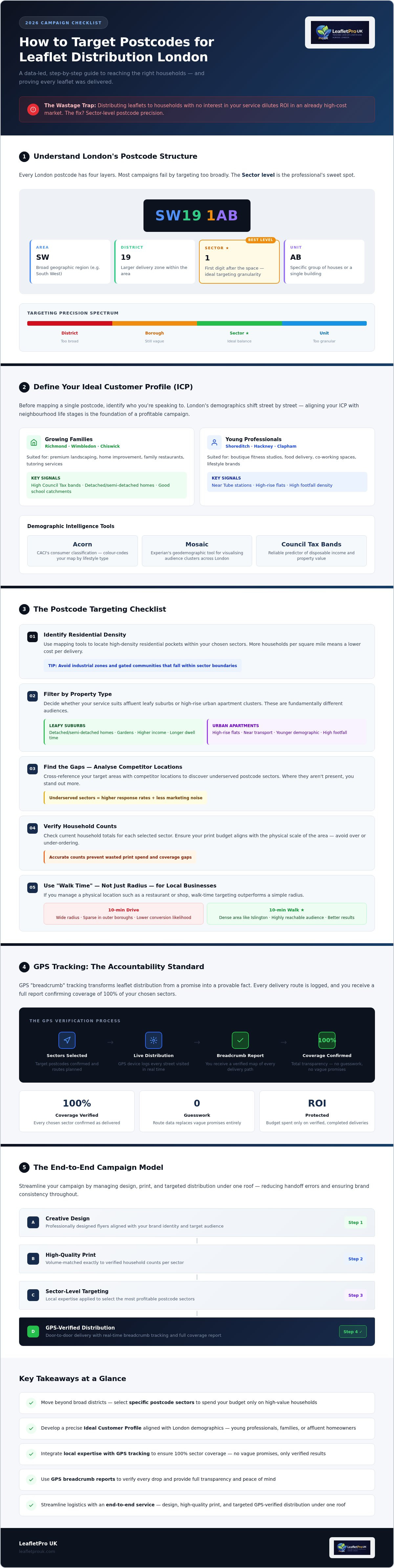
- Move beyond broad districts by selecting specific postcode sectors to ensure your marketing budget is spent only on high-value households.
- Develop a precise Ideal Customer Profile to align your campaign with specific London demographics, such as young professionals or growing families.
- Discover the most effective way to target postcodes for leaflet distribution London by integrating local expertise with systematic GPS tracking for every delivery.
- Use GPS "breadcrumb" reports to verify that your flyers have reached 100% of your chosen sectors, providing total transparency and peace of mind.
- Streamline your campaign logistics by utilising an end-to-end service that manages design, high-quality printing, and targeted distribution under one roof.
The Fundamentals of Postcode Targeted Flyer Delivery in London
Postcode targeting is the strategic process of selecting specific London sectors, such as SW19 1, rather than distributing flyers across broad districts like Wimbledon. In a city as complex as London, socioeconomic profiles shift dramatically between two adjacent streets. This makes a granular approach essential for any business looking to maximise their return on investment. If you don't understand how to target postcodes for leaflet distribution London effectively, you risk falling into the wastage trap. This happens when your marketing materials are delivered to households that have no interest in your service, diluting your ROI in a high-cost market. Professional marketers move beyond the Postcode District and focus on the Postcode Sector to find the perfect balance between reach and relevance.
Why Postcodes are the Gold Standard for London Marketing
London's residential layout is uniquely varied. Postcodes serve as a reliable proxy for household income, property type, and consumer behaviour. Whilst a shotgun approach might reach more letterboxes, the sniper precision of sector targeting ensures you only speak to your ideal audience. You achieve higher response rates by aligning your message with the specific lifestyle of a neighbourhood. This level of focus builds immediate local relevance. Residents often feel a higher level of trust toward businesses that appear to be operating just around the corner from them. By targeting specific sectors, you transform a generic flyer into a purposeful local invitation that residents are less likely to ignore.
London Postcode Structure 101
To master your campaign, you must first understand the anatomy of a London postcode. It breaks down into four distinct parts that help us organise your delivery with professional accuracy:
- Area: The broad geographic region, such as SW for South West or E for East.
- District: The larger delivery zone within that area, denoted by numbers like 19.
- Sector: The most important level for targeting, represented by the first digit after the space (e.g., SW19 1).
- Unit: A specific group of houses or a single building, defined by the final two letters.
Most successful campaigns focus on the sector level. This provides enough scale to make the logistics efficient whilst remaining precise enough to target specific street types. These sectors also help in organising distribution routes around London's complex road networks. By selecting sectors instead of districts, you ensure your team can navigate the capital with a clear plan, avoiding industrial areas or gated communities that don't match your customer profile.
Your Comprehensive Postcode Targeting Checklist
Executing a successful campaign requires a methodical approach to area selection. To master how to target postcodes for leaflet distribution London, you must first define your Ideal Customer Profile (ICP) through the lens of London life stages. A premium landscaping company might focus on families in Richmond, whilst a boutique fitness studio might find more success with young professionals in Shoreditch. Once your ICP is established, follow this essential checklist to refine your delivery plan:
- Identify density: Use mapping tools to find high-density residential pockets within your chosen sectors to maximise reach.
- Filter by property type: Decide if your service suits affluent "leafy" suburbs or high-rise urban apartment clusters.
- Find the gaps: Cross-reference your target areas with competitor locations to identify underserved postcode sectors.
- Verify counts: Check current household totals to ensure your printing budget aligns with the physical scale of the area.
Identifying Your Ideal London Demographic
Refining your map requires looking at specific local indicators. Council Tax bands and average house prices are excellent predictors of disposable income. Proximity to Tube stations also dictates the lifestyle and daily habits of residents in a particular sector. Many expert marketers use "Acorn" or "Mosaic" data to colour-code their London maps, allowing them to visualise exactly where their target audience clusters. If you manage a physical location like a restaurant or shop, consider "Walk Time" rather than just a radius. A 10-minute walk in a dense area like Islington often yields better results than a wider 10-minute drive in a more spread-out borough.
Mapping and Household Counts
Accurate household counts are vital for preventing waste. In central zones like EC or WC, you must distinguish between residential addresses and business-only postcodes. Delivering residential flyers to office blocks is a common logistical error that drains resources. You should also account for "dead drops." These are postcodes with high proportions of luxury flats that have restricted concierge access or strict "No Junk Mail" policies. Adjusting your volume based on the specific density of a London borough ensures your distribution remains efficient and cost-effective. If you need assistance in validating these numbers, seeking targeted distribution expertise can help you navigate these complex local variables with confidence.
Analysing London’s Unique Postcode Demographics
Success in the capital depends on your ability to decode the city's complex social fabric. London isn't a single market; it's a collection of distinct neighbourhoods, each requiring a tailored approach. For instance, West London (W/WC) remains the primary destination for brands targeting high-net-worth individuals and premium retail catchments. Conversely, the South West (SW) often experiences the "Nappy Valley" effect. This makes it an ideal territory for family-oriented services and home improvement sectors. Understanding these nuances is a core part of learning how to target postcodes for leaflet distribution London effectively.
Moving towards the North and North West (N/NW), you'll find a balance between gentrified pockets and deeply established residential communities. Meanwhile, the East and South East (E/SE) continue to capitalise on "New London" growth. These areas attract tech-savvy, younger audiences who respond well to modern, bold designs. Learning how to target postcodes for leaflet distribution London means matching your specific service to these regional personalities to ensure your message resonates with the person opening the letterbox.
The Gentrification Factor: Why 2026 Data Matters
You can't rely on decade-old maps in a city that evolves as fast as London. Areas like Peckham (SE15) or Hackney (E8) have undergone significant shifts, transitioning from budget-friendly zones to affluent creative hubs. Our 2026 data helps you spot these "up-and-coming" postcodes before your competitors do. We focus on micro-targeting, which is the practice of selecting specific streets amongst broader postcodes to ensure your flyers reach the most relevant households. This level of scrutiny prevents you from wasting materials on streets that no longer match your target demographic.
Postcode Density and Delivery Speed
Physical geography dictates your campaign's pace and efficiency. Whilst E14 (Canary Wharf) has extreme household density, it often takes longer to deliver due to complex security and lift access in high-rise buildings. In contrast, the classic terraced streets of Fulham (SW6) often provide the highest ROI because of their delivery efficiency. These areas allow for rapid, systematic coverage without the logistical hurdles of luxury towers. You must also account for Low Traffic Neighbourhoods (LTNs). These zones have become more prevalent in 2026, requiring distributors who understand how to navigate restricted road networks whilst maintaining a steady delivery schedule.
Ensuring Precision: The Role of GPS Tracking in Targeting
GPS-tracked distribution is the only definitive method to prove that your targeted postcode was covered 100%. Without this verification, even the most sophisticated demographic plan remains a theoretical exercise. A GPS report provides a "breadcrumb" trail. It shows the exact path taken by the distributor through your chosen London sectors. This level of visibility offers a significant psychological benefit; knowing your flyers reached the doormat reduces marketing anxiety and builds trust in the process. Over time, you can use this data to refine future campaigns by comparing which postcodes responded best against those that were fully delivered. Understanding how to target postcodes for leaflet distribution London requires this final layer of accountability to ensure your investment is protected.
Accountability in Every Letterbox
LeafletPro UK maintains a high standard of accountability by tracking every distributor in real-time across the target postcode. This systematic approach prevents "dumping" in communal bins, which is a common fear for London business owners navigating the city's many apartment complexes. GPS proof is the bridge between a targeting plan and a successful result. It ensures that the logistical method matches the initial strategic intent, providing a transparent record of every letterbox reached. By removing the guesswork, you can focus on the performance of your creative message rather than wondering if it was ever seen.
Refining Your Targeting with Delivery Data
True precision comes from analysing the intersection of delivery data and customer response. By overlaying response rates, such as QR code scans or unique coupon codes, onto your GPS delivery maps, you can see which streets are most profitable. This allows you to identify "black holes" in your delivery area where access was restricted or where residents were less receptive. You can learn how to track flyer distribution with our GPS guide to better understand these metrics. When you master how to target postcodes for leaflet distribution London, you treat every campaign as a data point for the next. This iterative process ensures your marketing spend is always moving towards higher efficiency and better conversion rates.
Launching Your Targeted Campaign with LeafletPro UK
LeafletPro UK operates as a diligent partner for businesses that value precision over volume. Whilst many national providers offer broad alternatives that lack local nuance, our team focuses exclusively on the capital. We combine deep-rooted local expertise with rigorous GPS tracking to ensure every campaign is executed to professional standards. Mastering how to target postcodes for leaflet distribution London is a complex task, but our systematic approach simplifies the logistics for you. By choosing a London-only specialist, you gain the peace of mind that comes from working with a team that understands the specific access challenges and residential profiles of every borough.
Our end-to-end service model is designed to remove the friction from your marketing journey. Instead of managing multiple vendors, you can rely on a single point of accountability for your design, print, and tracked delivery. This integrated approach ensures that the strategic intent of your campaign is maintained from the initial mapping stage to the final letterbox drop. We position ourselves as a sophisticated alternative to less organised competitors, providing the evidence and systematic proof required to justify your marketing spend.
Integrated Design and Print for London Brands
A targeted campaign is only as strong as the physical flyer that lands on the doormat. Your leaflet design must be tailored to the specific postcode you are targeting to achieve maximum resonance with residents. For instance, a campaign in Mayfair often requires luxury finishes and sophisticated typography, whilst a promotion in Shoreditch might benefit from a more modern, bold aesthetic. Our Leaflet Design Support helps you refine your message to suit these local expectations. We then provide high-quality printing as the final touch to your campaign, ensuring that the physical product reflects the credibility of your business. This end-to-end service keeps your design, print, and distribution under one roof, reducing the risk of logistical errors.
Request Your London Postcode Map Today
The first step toward a successful campaign is a clear visual plan. We encourage you to contact us for a no-obligation targeting consultation where we can build a bespoke postcode mapping proposal for your business. This plan identifies the most profitable sectors for your specific industry and aligns them with current 2026 household counts. Our service is built on transparency, offering GPS-backed guarantees and detailed reporting that proves every flyer was delivered as planned. When you understand how to target postcodes for leaflet distribution London with the help of a dedicated expert, your marketing becomes a predictable engine for growth rather than a series of vague promises.
Executing Your 2026 London Distribution Strategy
Success in the capital's competitive market requires moving beyond broad guesswork and embracing a data-led approach. By focusing on specific postcode sectors and verifying every drop with GPS technology, you eliminate the uncertainty that often plagues physical marketing. You now have the essential framework for how to target postcodes for leaflet distribution London, from defining your ideal demographic to navigating the logistical complexities of ULEZ and Low Traffic Neighbourhoods.
LeafletPro UK provides the expert mapping and demographic profiling needed to turn these insights into a high-performing reality. Our London-wide coverage ensures that your message reaches the right doormats with absolute transparency and full reporting. We act as your diligent partner, providing the accountability and precision your business deserves.
It's time to build a reliable local presence that delivers tangible results for your brand.
Frequently Asked Questions
How do I choose the best postcodes for my London business?
You select the most profitable areas by aligning your Ideal Customer Profile with local demographic data such as average house prices and Council Tax bands. Professional mapping tools allow you to visualise these clusters across the city. When learning how to target postcodes for leaflet distribution London, it's vital to focus on the sector level. This approach ensures your message reaches high-density residential pockets whilst avoiding industrial zones that don't match your business goals.
Is postcode targeted flyer delivery more effective than digital ads?
Targeted flyers offer a physical presence that digital ads cannot match, especially in a saturated market. Whilst digital marketing faces ad-blockers and high competition for attention, a physical leaflet sits on a resident's doormat. This tangibility often leads to higher local trust and better recall. For many London businesses, the combination of geographic precision and physical engagement provides a more reliable conversion rate than broad online campaigns that people often ignore.
Can I target specific streets instead of a whole postcode?
Yes, you can achieve street-level precision through micro-targeting techniques. Whilst campaigns usually focus on a postcode sector like SW19 1, we can refine the delivery to specific streets that match your property type requirements. This ensures you aren't wasting materials on luxury high-rises if you're looking for Victorian terraces. This granular level of control is essential for maintaining a high ROI in the capital's diverse residential landscape, where demographics can shift within a few yards.
What is the minimum number of leaflets for a targeted London drop?
Minimum quantities are typically determined by the density of the chosen London sectors and your specific campaign goals. A targeted drop in a dense borough like Islington will require a different volume than a spread-out area in the outer suburbs. We recommend aligning your volume with the total household count of your priority sectors to ensure full coverage. This systematic approach guarantees that your message isn't diluted across too wide an area, maintaining a strong local impact.
How do you ensure leaflets aren’t delivered to businesses in residential postcodes?
We use detailed residential mapping to distinguish between domestic addresses and commercial premises before the distribution begins. This sifting process is crucial in zones like EC or WC where offices and shops are prevalent. By focusing on residential sectors and providing clear instructions to our distributors, we ensure your flyers reach households. This methodical planning prevents wastage and ensures your marketing budget is spent on residents who can actually engage with your local service or product.
What happens if a distributor cannot gain access to a targeted block of flats?
If access is restricted due to security codes or concierge policies, the distributor logs the location as a "no access" point. This information is then reflected in your transparent delivery report. We don't leave flyers in communal lobbies or outside gates where they might be discarded. Instead, we prioritise the integrity of the delivery, ensuring that every leaflet that is successfully dropped reaches a verified residential doormat within your target area for maximum visibility.
How accurate is GPS tracking for leaflet distribution in London?
GPS tracking is exceptionally accurate, providing a meter-level record of the distributor's movements through the city's streets. Our system generates a real-time breadcrumb trail that confirms 100% coverage of your chosen sectors. This technology is the ultimate tool for anyone wondering how to target postcodes for leaflet distribution London with total confidence. It provides the systematic proof you need to verify that your investment has been handled with professional care and that every sector was reached.
How often should I repeat a drop in the same London postcode?
Repetition is key to building brand recognition amongst local residents. We often suggest a "rule of three" approach, where you repeat a drop in the same postcode at intervals of four to six weeks. This frequency ensures your brand remains top-of-mind without becoming intrusive. Consistent visibility within a specific London neighbourhood builds the familiarity and trust required to turn a local resident into a long-term, loyal customer who recognises your professional standard.


